
Editing cells
A cell is the smallest unit you translate: one paired piece of source and target text. Editing is meant to feel direct: click into a cell’s target side and type.
There is no Save button

Section titled “There is no Save button”Aquilla saves your work automatically. Your edit becomes a durable record when you naturally move on from the cell: when it loses focus, after a short idle pause, or when you release the edit. There’s nothing to commit, push, or publish.
This is a deliberate difference from the older Codex editor: no Ctrl+S, no
“commit all”, no “publish”. You translate, you move on, and it’s saved.
Enter confirms; Shift+Enter adds a line break
Section titled “Enter confirms; Shift+Enter adds a line break”Press Enter to confirm your edit: it commits the cell’s current text and exits, the same as clicking away. If a translation needs more than one line, press Shift+Enter instead: it inserts a hard line break inside the cell without confirming or exiting, so you can keep typing.
Typing a translation into a cell yourself also marks it validated by you: the cell’s indicator turns emerald in the same gesture, no separate review step. See Validation for the full picture.
Saved locally first, then synced
Section titled “Saved locally first, then synced”When you make an edit, Aquilla first writes it to a local outbox in your browser, then sends it to the server when the connection is healthy. The benefit: your work survives a brief network drop, since your edits wait safely in the outbox and drain out once you’re back online.
A status indicator at the bottom of the workspace shows the current sync state (Live and Synced when everything has reached the server, queued or offline otherwise), so you always know where your latest edits are. See Real-time sync & presence.

Selecting several cells
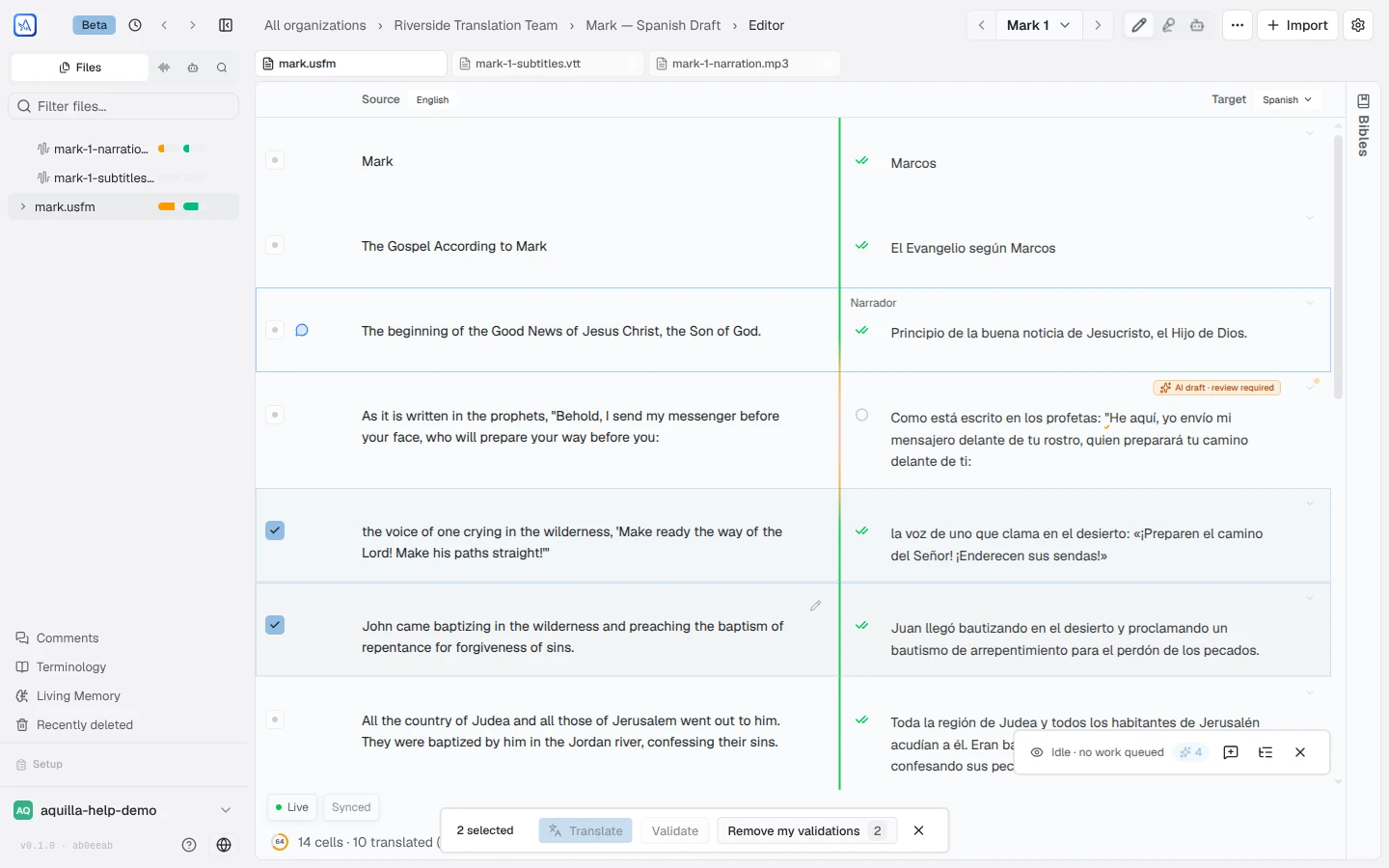
Section titled “Selecting several cells”Every cell row starts with a small checkbox (“Select cell. Drag to select a range.”). Tick one and a Selection actions toolbar appears above the editor with the count and the bulk actions: Translate, Validate, Remove my validations, and, where the selection supports them, Voice together and Harmonize…. Each button enables only when it applies to what you selected; Clear selection (or Esc) dismisses the bar. Extend a selection by dragging across checkboxes or Shift-clicking another cell’s box.
The cell detail panel
Section titled “The cell detail panel”Click a cell (or its Open cell details arrow) to expand its detail panel, with tabs for:
- Retrieval support: how well-supported this cell is: its endorsement count and a support percentage, with a hint when it deserves a closer look;
- Back-translation: read your translation back in the source language, to sanity-check meaning;
- Footnotes: shown when the cell has footnotes, for reading and editing them in place;
- Recording: recordings and transcription for the cell;
- Issues: any check violations on the cell; and
- Metadata: appears only when a cell carries extra information imported with it (for example from a linked Door43 resource), shown as a read-only key/value list such as its source reference or occurrence count.
The tabs adjust to the cell, showing only what applies to it. A cell’s edit history isn’t a tab here at all: open it any time from the History button on the action rail (tooltip “Edit history”), which slides in a history drawer beside the cell.
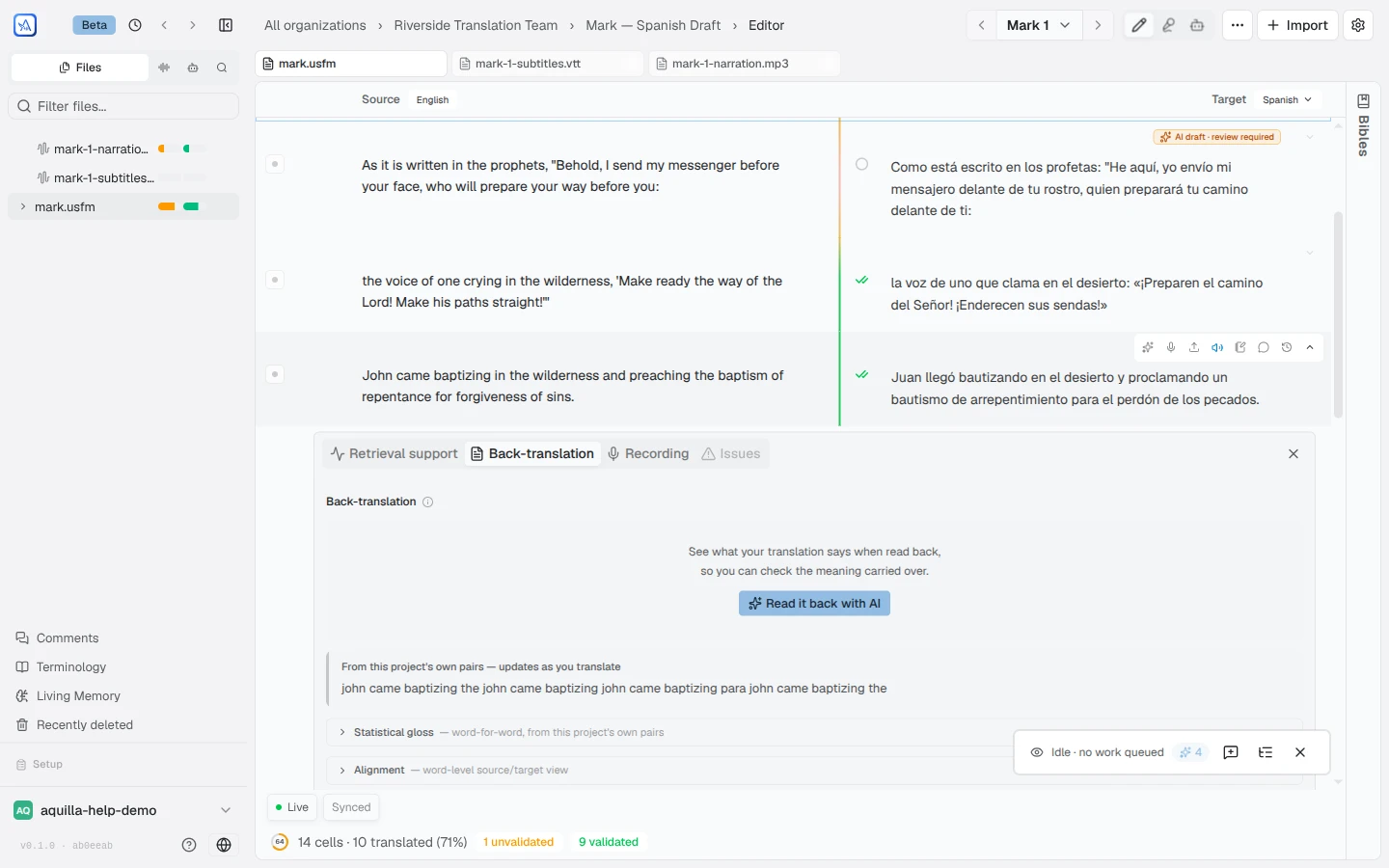
The action rail (AI, audio, footnotes, comments, History) appears when
you hover or focus a cell, and stays pinned open for as long as that cell
stays focused, so you’re free to move your mouse away. A paragraph’s
first cell also carries a Draft paragraph button: see
The AI copilot. Done with the detail panel? Click the explicit X (“Close cell details”) in its corner,
or use Esc or the collapse chevron.
A footnote on the target side shows as a small numbered badge; its preview keeps any bold, italic, or underline formatting from the note itself. Click the badge to reopen the note for editing. On a read-only cell it’s just a plain marker.
What if two people edit the same cell?
Section titled “What if two people edit the same cell?”While you’re focused on a cell, your client holds a brief, soft focus lock, and teammates see that you’re editing it, so collisions are rare by design.
If two people do edit the same cell while offline, Aquilla keeps it simple: the first edit to reach the server “wins” and becomes the cell’s current value. The other edit survives: it’s preserved in the cell’s history as a recoverable earlier version, so nothing is lost.
Help assistant
AI answers from the Aquilla docs — may make mistakes.